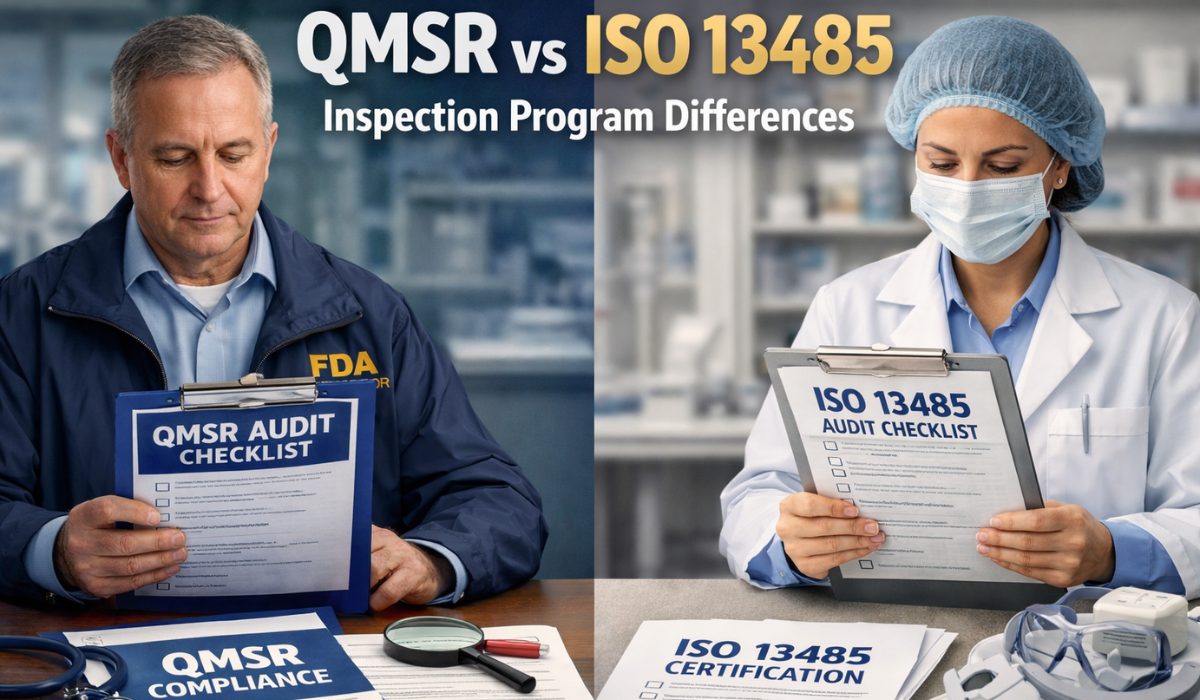
Introduction: Navigating the QMSR vs ISO 13485 Landscape
The global medical device industry is witnessing a pivotal shift as the FDA harmonizes its Quality System Regulation (QSR) with the international ISO 13485:2016 standard. This evolution has birthed the Quality Management System Regulation (QMSR), creating a unified framework for quality oversight. However, understanding the QMSR vs ISO 13485 inspection program differences is essential for manufacturers who must satisfy both US federal investigators and international registrars.
While the QMSR incorporates ISO 13485 by reference, the two are not identical in their enforcement. The FDA maintains specific statutory requirements that go beyond the international standard. Consequently, your audit strategy must account for these additional layers of complexity. In 2026, a “one-size-fits-all” approach to quality auditing is no longer sufficient to guarantee success during a site visit.
In this guide, we analyze the structural and procedural variances between these two frameworks. We explore how the FDA QMSR Inspection Program Rule Interpretation impacts your daily operations. By mastering these differences, you can build a resilient Quality Management System (QMS) that thrives under the scrutiny of any regulatory body worldwide.
The Core Philosophical Alignment
The primary goal of the QMSR transition is to reduce the regulatory burden on global manufacturers. By aligning with ISO 13485, the FDA acknowledges that a risk-based approach is the most effective way to ensure device safety. This alignment means that for the first time, US and international quality expectations are largely synchronized.
However, the FDA’s “inspectional” mindset differs from an ISO registrar’s “audit” mindset. Registrars focus on conformity to the standard for certification. In contrast, the FDA focuses on the legal requirement to protect public health. This subtle difference influences how questions are asked and how evidence is evaluated.
To bridge this gap, many firms are adopting a Medical Device QMSR Inspection Program Template. This tool helps ensure that while you meet ISO requirements, you do not overlook the specific statutory obligations unique to the US market.
Key Differences in Documentation and Reporting
One of the most significant QMSR vs ISO 13485 inspection program differences lies in documentation. While ISO 13485 provides a framework for quality records, the FDA has specific mandates for “Medical Device Reporting” (MDR) and “Reports of Corrections and Removals.” These are legal requirements under the Food, Drug, and Cosmetic Act that remain active in the QMSR era.
Investigators will look for a direct link between your complaint handling system and these mandatory reports. ISO audits may focus on the effectiveness of your complaint resolution process, but the FDA will prioritize the timeliness and accuracy of your regulatory filings. Failure to report a malfunction correctly is a high-frequency cause for a Form 483.
Furthermore, the FDA maintains strict expectations for record-keeping that must be accessible to investigators. If you are struggling with the technical setup, understanding how to implement medical device inspection program QMSR can provide a roadmap for organizing your digital and physical archives to satisfy federal inspectors.
Risk Management: Global Standard vs. Federal Oversight
ISO 13485:2016 explicitly requires a risk-based approach throughout the QMS. The QMSR adopts this, making risk management the “red thread” of the entire system. However, the FDA’s interpretation of risk often extends deeper into the clinical impact of manufacturing failures than some ISO audits.
During a QMSR inspection, the investigator will trace a high-risk failure mode from the design phase all the way to the production floor. They want to see that the controls you established during design are actually functioning in real-time. ISO audits often verify the existence of the risk process, whereas the FDA verifies the implementation of the risk controls.
Because of this depth, many firms choose to follow a Step-by-Step Medical Device Inspection Program for QMSR Compliance. This structured approach ensures that every risk control is verified and documented before it is ever presented to a federal investigator.
The Role of Mock Audits in Harmonization
Given the complexities of QMSR vs ISO 13485 inspection program differences, a simulated evaluation is more valuable than ever. A mock audit allows you to pressure-test your system against both sets of requirements simultaneously. It identifies where your ISO-compliant processes might fall short of FDA expectations.
Mock audits should be performed by experts who understand the “QSIT” (Quality System Inspection Technique) used by the FDA. This technique focuses on four primary subsystems: Management Controls, Design Controls, CAPA, and Production and Process Controls. An ISO audit may not follow this specific path, which can leave teams unprepared for the FDA’s investigative flow.
If you are questioning the necessity of such a simulation, it is helpful to explore: Do You Need a Mock FDA Audit? Benefits and What to Expect. A mock audit provides the objective evidence needed to prove that your integrated QMS is actually functioning as a unified whole.
Technical Variances in Labeling and Traceability
The FDA has specific requirements for Unique Device Identification (UDI) that are highly prescriptive. While ISO 13485 requires traceability, the US UDI system has strict data submission and formatting rules. A QMSR inspection will specifically target the accuracy of your UDI data in the GUDID database.
Additionally, the FDA’s rules for “Labeling and Packaging” are more detailed than the high-level requirements in the ISO standard. Investigators will verify that every claim on your label is supported by your Design History File (DHF). They will also check that your labeling process prevents mix-ups, a common area for 483 observations.
Utilizing a QMSR Inspection Program Checklist for Medical Devices can help ensure that these technical nuances are verified during your internal reviews. This prevents small labeling errors from escalating into significant regulatory findings
Management Responsibility: The FDA Perspective
In the QMSR framework, management responsibility is a critical focus area. The FDA expects senior leadership to not only establish the QMS but to actively monitor its effectiveness. This includes ensuring that adequate resources are provided for quality and that the quality policy is communicated at all levels.
While ISO 13485 also emphasizes management commitment, the FDA’s investigators often conduct more intensive interviews with senior executives. They want to see that quality is not just a department, but a core business strategy. If an investigator finds systemic issues, they will look to management for the root cause of the failure.
This is why having a robust “War Room” strategy is essential. Your management team must be trained on how to articulate their involvement in the QMS. They must demonstrate that they receive and act upon data regarding the health of the quality system.
Conclusion: Building a Unified Audit Strategy
The QMSR vs ISO 13485 inspection program differences represent a bridge between international best practices and federal law. While the harmonization efforts have made compliance more efficient, they have not removed the need for precision. Manufacturers must build a QMS that satisfies the “how” of ISO and the “what” of the FDA.
As we progress through 2026, the firms that succeed will be those that integrate these requirements seamlessly. By focusing on risk management, digital integrity, and proactive auditing, you can ensure that your facility is ready for any inspector, at any time. Treat compliance as a competitive advantage that protects your patients and your market share.
Frequently Asked Questions (FAQs)
1. Does the QMSR replace ISO 13485 for US manufacturers? No, the QMSR incorporates ISO 13485:2016 by reference. US manufacturers must comply with the QMSR, which essentially means they must follow ISO 13485 plus additional FDA-specific requirements.
2. Will an ISO 13485 certificate satisfy an FDA investigator? No. While the FDA acknowledges the certificate as evidence of a QMS, they will still conduct their own independent inspections to verify compliance with US federal law.
3. What is the most common reason for 483s in the QMSR era? Failures in CAPA investigations and inadequate risk management integration remain the leading causes of regulatory findings.
4. How does the FDA’s “inspectional” mindset differ from an ISO audit? FDA investigators act as federal agents looking for legal violations that impact public safety, whereas ISO auditors act as assessors verifying conformity to a standard.
5. Are mock audits mandatory under the new QMSR? Internal audits are mandatory, but mock audits are a highly recommended best practice to ensure your internal audit program is truly effective.
6. Can I use the same checklist for ISO and QMSR audits? You should use an integrated checklist that covers all ISO clauses plus the specific FDA statutory requirements for reporting, UDI, and labeling.
References and Technical Citations
FDA QMSR Final Rule (2026): https://www.fda.gov/medical-devices/postmarket-requirements-devices/quality-management-system-regulation-qmsr This official document details the specific amendments to 21 CFR 820 that create the QMSR and harmonize it with ISO 13485.
ISO 13485:2016 Quality Management Systems Standard: https://www.iso.org/standard/59752.html The primary international standard for medical device quality management that serves as the foundation for the new FDA QMSR framework.
FDA Inspection Guides (QSIT) Technical Manual: https://www.fda.gov/inspections-compliance-enforcement-and-criminal-investigations/inspection-guides/quality-system-inspection-technique-qsit A guide detailing how federal investigators evaluate quality system subsystems during an on-site facility audit.
FDA Data Integrity and Compliance with cGMP: https://www.fda.gov/regulatory-information/search-fda-guidance-documents/data-integrity-and-compliance-cgmp-guidance-industry Technical guidance ensuring that all quality records—whether electronic or paper—are accurate, reliable, and secure.
IMDRF Principles of Software Validation: https://www.imdrf.org/documents/software-as-a-medical-device-samd-key-definitions-and-framework The international framework for validating digital systems, essential for maintaining compliance in an increasingly automated industry.
European Medical Device Regulation (EU MDR 2017/745): https://health.ec.europa.eu/medical-devices-sector/new-regulations_en The EU’s comprehensive regulation that works in tandem with QMSR to drive global quality management harmonization through ISO 13485.