The Critical Importance of Document Accuracy
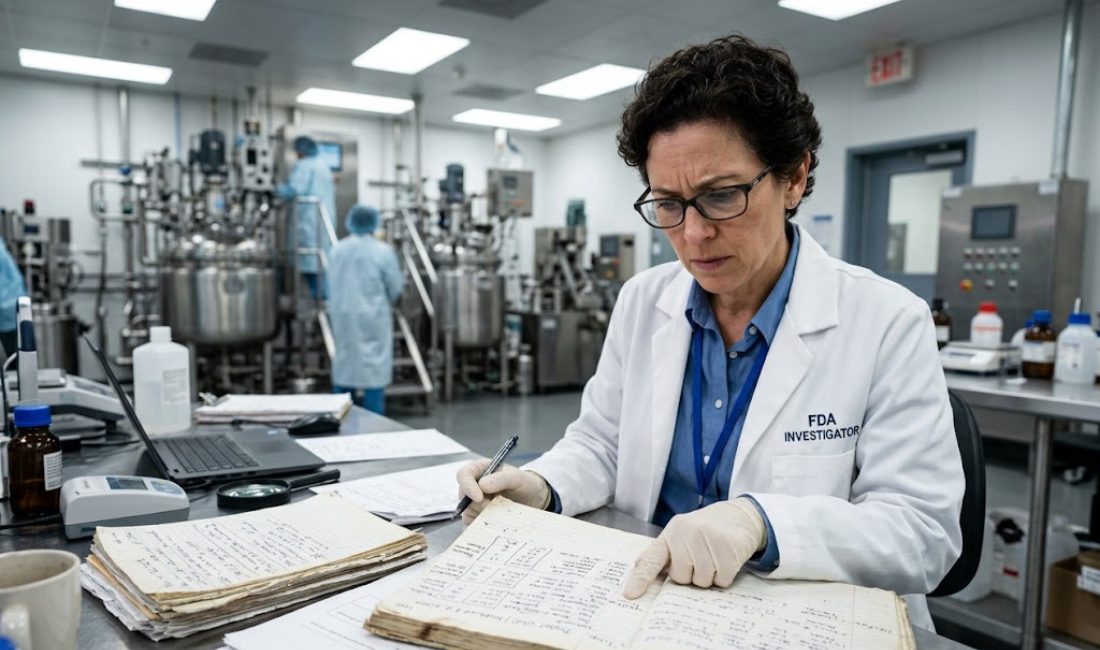
Regulatory investigators operate under one fundamental principle. If you did not document an action, it did not happen. Consequently, Documentation Failures FDA findings represent the most common category of Form 483 observations. Quality Assurance directors must understand that a batch record is a legal document. It proves a product’s safety, identity, and purity. Even a minor clerical error casts doubt on an entire year of data. Such errors lead to costly recalls and regulatory delays.
A successful inspection outcome depends on your facility’s paperwork. Specifically, you must demonstrate a “state of control.” The agency focuses heavily on contemporaneous record-keeping. If staff records data hours after a task ends, the FDA concludes the Quality System is broken. Therefore, accuracy is the only way to safeguard your operational license. By prioritizing documentation integrity today, your facility avoids severe enforcement actions.
Failing to Record Activities Contemporaneously
The most frequent documentation failure involves timing. The FDA expects all data recording to happen at the time of work. However, many facilities struggle with analysts who use “scrap paper.” These analysts often intend to transfer data to the official record later. This practice violates ALCOA+ principles significantly. When an investigator finds sticky notes on the production floor, they cite the firm. This citation highlights a lack of contemporaneous documentation.
This failure often suggests that employees face too much pressure. If staff lacks time to document correctly, product integrity suffers. Understanding How FDA Investigators Conduct GMP Inspections reveals their tactics. They often watch operators in real-time. They check if operators document steps immediately. If you identify this habit during a self-audit, implement retraining immediately. Internal correction prevents these habits from becoming permanent regulatory marks.
Missing Signatures and Inadequate Reviews
A signature in a GMP environment represents a personal attestation. It proves a person performed a specific task correctly. Consequently, missing signatures in batch records serve as immediate red flags. Furthermore, the FDA emphasizes the “Second-Person Review.” If your Quality Unit (QU) fails to verify manufacturing steps, the system lacks redundancy. Investigators often find that “Checkers” sign records without verifying the data. This laziness destroys the safety net of the Quality System.
Firms must ensure that every critical step has a timestamped signature. If a gap analysis reveals missing signatures, it indicates a systemic failure. This issue is a common reason Why Contract Testing Laboratories Receive FDA Warning Letters. Contract labs must prove that a qualified second individual reviewed every test result. Without this verification, the scientific validity of the testing fails. Transparency remains the only path to maintaining regulatory trust.
Inadequate Investigation of Deviations
The way a company documents failures is vital. Investigators meticulously review deviation reports and Out-of-Specification (OOS) investigations. A common documentation failure is the “superficial” investigation. This happens when a firm fails to document a thorough root cause analysis. If your record simply states “human error,” the FDA will view it as inadequate. They expect more than just “retraining” as a corrective action.
A compliant record provides a transparent narrative. It explains what happened and why it happened. Furthermore, it details how you will prevent a recurrence. The FDA Guidance on Investigating OOS Test Results provides the roadmap. If your documentation shows you ignored failing results, you face major enforcement risks. Knowing How FDA Investigators Evaluate Quality Systems helps you. It shows that investigators view your logs as a window into your quality culture.
Unofficial Records and Shadow Documentation
Shadow documentation refers to unofficial logs or notebooks. These are not part of the validated Quality Management System. Investigators look for these “hidden” records during walkthroughs. They check desk drawers, trash cans, and personal storage. If an investigator finds a spreadsheet tracking “glitches” outside the deviation system, they destroy the firm’s credibility. This practice suggests that the company intentionally hides non-compliance from the regulator.
Laboratories and manufacturing floors must have strict policies against unofficial records. All data must reside on controlled and issued forms. This level of control is essential for FDA Inspection Preparation for Food and Dietary Supplement Facilities. In those sectors, high-volume operations often lead to informal “checklists.” By centralizing all documentation, you ensure that every piece of data is transparent.
Poor Data Integrity in Electronic Records
As facilities transition to digital systems, the focus has shifted. Documentation Failures FDA findings now target electronic records frequently. The agency expects all digital data to comply with 21 CFR Part 11. A frequent failure involves the lack of “Audit Trail Reviews.” If your Quality Unit never reviews system logs, you cannot prove data integrity. Investigators check if users have “Delete” privileges. These privileges allow users to change results without leaving a trace.
Firms must implement strict user access controls. Furthermore, you must conduct periodic digital audits. Understanding How FDA Detects Data Integrity Manipulation in Laboratories is critical. If the electronic “original” does not match the printed summary, the FDA concludes the documentation is fraudulent. Maintaining a validated system is the only way to satisfy forensic audit requirements in 2026.
Incomplete Training Records and Gaps
Training records provide evidence that employees are qualified. During an inspection, the FDA will select an operator. They will then ask to see that operator’s training file. A common failure is the “incomplete” record. This happens when an employee performs a task before receiving official competency sign-off. Furthermore, investigators look for “read and understand” training. They prefer training that includes a practical assessment.
Management must maintain a real-time training matrix. This matrix prevents untrained staff from accessing GMP areas. This is a cornerstone of FDA Inspection Preparation for Biologics Manufacturers. In that sector, aseptic processing requires advanced technical competency. If your documentation cannot prove staff qualifications, the investigator will question every batch. A robust training record is your first line of defense.
Blank Forms and Pre-Dating Errors
The discovery of pre-signed forms is a critical violation. This often leads to an escalation to the Office of Criminal Investigations. Investigators check for batch records where the signature date is early. Furthermore, they look for “blank forms” signed in advance. These practices constitute intentional fraud. They signal a complete breakdown of the quality culture. No investigator will trust a firm that pre-dates its legal documents.
Quality Units must perform regular “floor audits.” These audits ensure that no signed blank forms exist. This level of scrutiny is also vital in FDA Inspection Preparation for Medical Device Companies. In that field, device history records must be impeccably timed. If your documentation suggests you are “predicting” results, you lose the agency’s trust permanently. Transparency remains the only path to success.
Inadequate Change Control Documentation
Every change to a process or piece of equipment requires documentation. A common failure involves “unauthorized changes.” This happens when a firm modifies a system but fails to update SOPs. During an audit, investigators compare physical equipment against diagrams. If they find a new valve without change control documentation, they cite a process control failure. These “shadow changes” suggest that the facility is not in a state of validation.
A compliant change control record must include a detailed rationale. Furthermore, it must assess the impact on product quality. You must also prove that all personnel received retraining before the change. Understanding FDA Inspection Trends: What Investigators Are Focusing on Now reveals this priority. The agency increasingly targets changes that happen outside the QMS. By maintaining a rigorous change control log, you prove your facility stays compliant.
Conclusion
Documentation is the heartbeat of GMP compliance. While Documentation Failures FDA findings are common, you can prevent them. Focus on contemporaneous recording and thorough investigations. Furthermore, maintain validated electronic systems. These steps ensure your facility is always ready for a regulatory visit. Your records prove to the world that your products are safe for patients. A robust documentation strategy is the ultimate investment in your company’s regulatory success.
FAQs
1. What are the most common documentation errors? The most frequent errors include non-contemporaneous entries and missing signatures. The use of unofficial notebooks or “scrap paper” also ranks high.
2. How does the FDA view “white-out” on a GMP document? The use of “white-out” is strictly prohibited. You must cross out errors with a single line. Then, initial and date the change.
3. What is a “contemporaneous” record? A record is contemporaneous when you create it at the same time as the activity. The FDA does not allow “end-of-shift” documentation.
4. Why are electronic audit trails so important? Audit trails provide an unalterable history of data. They are the primary tool investigators use to detect data manipulation.
5. Can a missing signature lead to a Warning Letter? A single error usually leads to a 483. However, a systemic pattern across departments can lead to a Warning Letter.
6. How long should we keep batch records? Under cGMP, keep batch records for at least one year after the expiration date. Many firms keep them longer for legal protection.
References
- FDA 21 CFR Part 211 – Records and Reports – This regulation governs documentation requirements for pharmaceuticals.
- FDA Guidance: Data Integrity and Compliance with CGMP – The official Q&A regarding ALCOA+ principles.
- WHO Technical Report Series 996 – Annex 5 – The international standard for maintaining accurate records in life sciences.
- PIC/S Aide-Memoire: Data Management – A checklist used by global inspectors to evaluate documentation.
- EMA Questions and Answers: Good Manufacturing Practice – European regulatory insights into record retention standards.
Forward-thinking Quality Directors often identify these systemic paperwork gaps early. They utilize a mock FDA inspection led by former agency investigators to spot vulnerabilities. To ensure your facility remains compliant and to build authority, explore expert FDA Inspection Readiness and learn How Gap Analysis Prevents FDA Enforcement Actions. Implementing these professional assessments ensures your records remain beyond reproach.