
GDP Compliance Checklist for Pharmaceutical Logistics Companies
Introduction
In the pharmaceutical industry, the responsibility for product quality does not end when a drug leaves the manufacturing facility. The journey from the plant to the pharmacy or hospital is a critical phase where a product’s safety, efficacy, and integrity are at constant risk. This is where Good Distribution Practices (GDP) become paramount. For logistics companies, adhering to these regulations is not just a matter of compliance; it is a fundamental pillar of patient safety. This article provides a comprehensive GDP compliance checklist for pharma logistics, designed to help you navigate the complexities of the supply chain and ensure your operations are inspection-ready.
What are Good Distribution Practices (GDP)?
Good Distribution Practices are a quality system for warehouse and distribution centers dedicated to medicinal products. Regulatory agencies like the FDA and EMA mandate Good Distribution Practice (GDP). These rules actively safeguard the quality and integrity of medicines. As a result, they protect the product throughout the entire supply chain.
The core of GDP is twofold. It stops counterfeit medicines from entering the supply chain. This includes managing everything from the temperature of a shipping container to the training of a delivery driver. A lapse in GDP can render a life-saving medication ineffective or even harmful.
The Ultimate GDP Compliance Checklist for Pharma Logistics
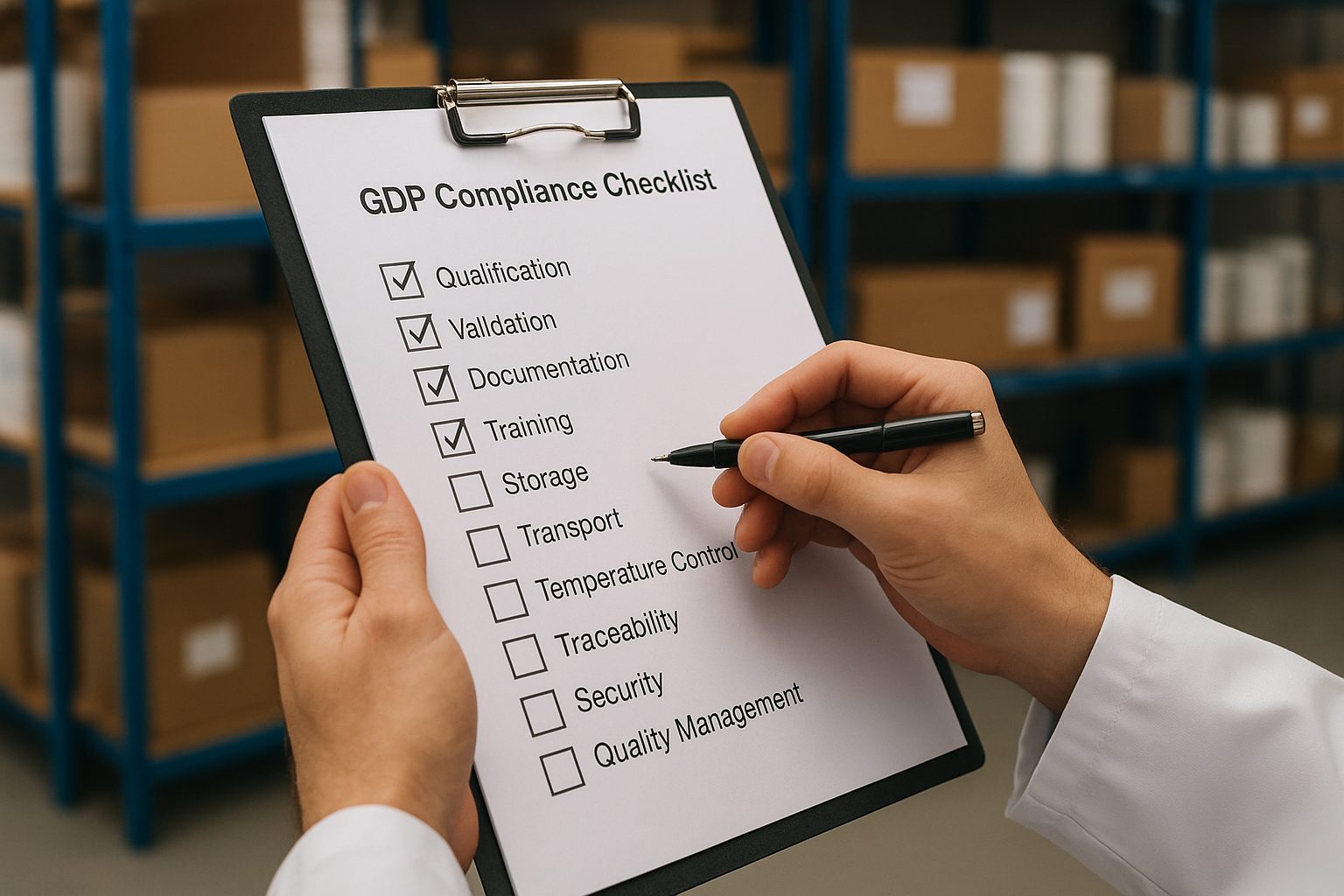
A successful GDP program relies on a strong foundation. It requires meticulous planning, detailed documentation, and precise execution. Use this detailed checklist to assess your operations, identify potential gaps, and build a culture of continuous compliance. This is your essential GDP compliance checklist for pharma logistics.
1. Quality Management System (QMS)
Your QMS is the documented framework that defines your commitment to quality. It should be fully implemented and regularly reviewed.
- Quality Policy: Have you established a formal quality policy endorsed by senior management?
- Procedures (SOPs): Are all GDP-related activities governed by clear, controlled, and up-to-date Standard Operating Procedures?
- Management Review: Does senior management conduct periodic reviews of the QMS to ensure its continuing suitability and effectiveness?
- Quality Risk Management: Do you have a formal process for identifying, assessing, and mitigating risks to product quality throughout the distribution process?
2. Personnel
Your employees are your first line of defense in maintaining product integrity.
- Organizational Chart: Is there a clear organizational chart showing the roles, responsibilities, and reporting lines of all personnel?
- Responsible Person (RP): Have you appointed a specific person to oversee the Quality Management System (QMS)? Does this individual have the clear authority and responsibility to implement and maintain it?
- Training: Do all employees receive initial and ongoing training relevant to their specific duties? Is this training documented and its effectiveness periodically assessed?
- Hygiene: Are there written hygiene policies in place that are understood and followed by all personnel?
3. Premises and Equipment
You must design and maintain your facilities and equipment to safeguard products. This prevents contamination, degradation, and security threats.
- Storage Areas: Are storage areas clean, dry, and maintained within acceptable temperature limits?
- Temperature and Environment Control: Do you use calibrated equipment to control temperature and humidity? Have you conducted a temperature mapping study to identify hot and cold spots?
- Equipment Validation and Calibration: Is all critical equipment (e.g., refrigerators, data loggers, freezers) qualified, validated, and on a regular calibration and maintenance schedule?
- Security: Are premises secure to prevent unauthorized access? Are high-value or controlled substances stored in an area with additional security measures?
4. Documentation and Records
If it isn’t documented, it didn’t happen. Meticulous record-keeping is the cornerstone of GDP.
- Traceability: Can you trace any product from receipt to delivery? Do records show the source, destination, and batch number for every transaction?
- Record Retention: Do you retain all records for the period required by national legislation (typically several years)?
- Electronic Systems: Do you validate all your electronic systems? Consequently, does this process ensure your data is accurate, consistent, and secure? Managing digital records correctly is crucial, raising the question: Can AI Tools Be Compliant with FDA Part 11? What You Need to Know.. A robust GDP compliance checklist for pharma logistics must include provisions for digital record integrity.
5. Operations and Receiving
Your operational procedures must ensure that products are handled correctly from the moment they arrive.
- Supplier and Customer Qualification: Do you have a process to qualify suppliers and customers? Furthermore, does it confirm they are authorized to handle medicinal products?
- Receiving Inspections: Do you inspect all incoming shipments to verify the product’s identity, quantity, and condition? Are containers checked for damage and seal integrity?
- Stock Segregation: Do you have clearly demarcated and controlled areas for quarantined, rejected, returned, and recalled products to prevent mix-ups?
6. Transportation and Shipping
This is the most dynamic and high-risk phase in logistics. A robust GDP compliance checklist for pharma logistics must heavily focus on this area.
- Containers and Vehicles: Are the vehicles and containers used for transport suitable for use and equipped to protect goods from damage and adverse weather conditions?
- Temperature Control: For temperature-sensitive products, are you using qualified active or passive temperature-controlled containers and vehicles? Are temperature data loggers used for every shipment?
- Route Risk Assessment: Have you performed risk assessments on your shipping lanes to identify and mitigate potential delays or environmental hazards?
- Security in Transit: Are there measures in place to protect products from theft or tampering during transit?
7. Complaints, Returns, Recalls, and Falsified Products
You must have a system to handle deviations and protect the public from potentially harmful products.
- Complaint Handling: Do you have a written procedure for investigating all product-related complaints to identify the root cause and implement corrective actions?
- Returns Management: Does your procedure for handling returns require a qualified person to conduct a risk assessment before any product is restocked for sale?
- Recalls: Can you rapidly and effectively execute a product recall at any point in the supply chain? Is this system tested periodically? The consequences of a failed recall are immense, as shown in analyses of Recent FDA Recalls in Dietary Supplements: Lessons Learned.
Bridging GDP with Good Manufacturing Practices (GMP)
GMP governs quality in manufacturing, while GDP protects that quality during distribution to the end-user. A failure in distribution can negate all the quality efforts made during manufacturing. Many of the principles of a QMS, such as documentation, training, and deviation management, are identical. Understanding common manufacturing failures, like those outlined in Top 7 GMP Audit Findings—and How to Correct Them Effectively can provide valuable lessons for logistics providers.
Preparing for a Regulatory Inspection
A GDP compliance checklist for pharma logistics is your best tool for inspection readiness. Conduct regular, rigorous internal audits against this checklist to identify and fix issues proactively. Treat these internal audits as if they were real regulatory inspections. This will train your team and test your systems under pressure. Preparing for scrutiny is a universal challenge in regulated industries, and insights can be drawn from other sectors, as seen in guides like In Vitro Diagnostics: Navigating Your First FDA Inspection.
The Future of GDP Compliance
The logistics landscape is evolving rapidly. Regulators are prioritizing supply chain security, data integrity, and complete visibility. Technologies like blockchain for traceability and IoT sensors for real-time monitoring are becoming more common. Staying compliant means staying informed about these evolving expectations. A forward-looking view, such as that provided in 2025 FDA Inspection Trends in the Pharmaceutical Industry can help you anticipate future requirements and build a more resilient compliance program.
Conclusion
For pharmaceutical logistics companies, GDP compliance is not an option; it is the license to operate. A breakdown in the supply chain is a breakdown in patient care. This GDP compliance checklist for pharma logistics provides a framework for building a robust quality system that protects product integrity, satisfies regulatory requirements, and ultimately safeguards public health.
By embracing a culture of continuous improvement and using this checklist to conduct regular self-assessments, you can move beyond simply reacting to regulations. You can proactively manage risks, enhance your operational excellence, and solidify your position as a trusted partner in the complex and vital pharmaceutical supply chain.
Frequently Asked Questions (FAQs)
Who is the “Responsible Person” (RP) in GDP?
A company designates a specific Responsible Person for its quality management system (QMS). This individual holds the clear authority and responsibility to implement and maintain the system. Ultimately, they ensure the QMS fully complies with all GDP regulations.
What is temperature mapping?
Temperature mapping is a process that analyzes the temperature distribution within a storage area. Specifically, this study identifies the location of the hottest and coldest spots. Ultimately, this data is used to confirm that you can maintain consistent temperature control.
What are the key elements of cold chain management?
Cold chain management involves using qualified temperature-controlled packaging and transportation, continuous temperature monitoring, and having clear procedures for handling temperature excursions (deviations).
Are third-party transport providers also subject to GDP?
As the contracting company, you are responsible for all outsourced activities. Therefore, you must ensure these services, including transportation, fully comply with GDP. This requires qualifying your third-party providers and having a formal quality agreement in place.
How often should GDP training be conducted?
All personnel should receive initial GDP training when they join the company and then receive regular, ongoing training (e.g., annually) to ensure they remain up-to-date with procedures and regulations.
References
WHO Good Storage and Distribution Practices for Medical Products: Comprehensive guidelines from the World Health Organization that serve as a global benchmark for GDP. https://www.who.int/publications/i/item/9789240009282
European Commission Guidelines on Good Distribution Practice of medicinal products for human use (2013/C 343/01): The official GDP guidelines for the European Union, which are highly influential globally. https://eur-lex.europa.eu/LexUriServ/LexUriServ.do?uri=OJ:C:2013:343:0001:0014:EN:PDF
FDA – 21 CFR Part 205 – Guidelines for State Licensing of Wholesale Prescription Drug Distributors: While the US does not have a single federal GDP regulation, this part provides foundational requirements for wholesale distribution. https://www.ecfr.gov/current/title-21/chapter-I/subchapter-C/part-205
Pharmaceutical Inspection Co-operation Scheme (PIC/S) Guide to Good Distribution Practice: A harmonized GDP standard used by numerous regulatory authorities around the world. https://picscheme.org/en/publications
United States Pharmacopeia (USP) General Chapter <1079>: Provides detailed guidance and best practices for good storage and shipping of drug products. https://www.uspnf.com/sites/default/files/usp_pdf/EN/USPNF/revisions/gc-1079-rb-notice-20210226.pdf
International Air Transport Association (IATA) – Temperature Control Regulations (TCR): The global standard for transporting temperature-sensitive healthcare products by air. https://www.iata.org/en/publications/store/temperature-control-regulations/