
What FDA Investigators Look for in Laboratory Records
The Strategic Importance of Analytical Documentation
Regulatory investigators view laboratory data as the primary evidence of a product’s safety and efficacy. Consequently, during a site visit, the scrutiny of Laboratory Records FDA processes becomes the central focus of the entire audit. Investigators assume that if the record is incomplete, inaccurate, or missing, the underlying analytical work never occurred. For Quality Assurance directors and laboratory managers, maintaining impeccable documentation is not just a clerical task. Instead, it is a critical defense mechanism that protects the firm’s operational license and market reputation.
A successful inspection outcome depends on the laboratory’s ability to demonstrate a “state of control” over its data. The FDA utilizes a forensic approach to identify patterns of data manipulation or unauthorized corrections. Therefore, firms must ensure that their records tell a complete, transparent story of every test performed. By prioritizing documentation integrity today, your facility can avoid the severe consequences of Form 483 observations. This proactive commitment remains essential for successful FDA Inspection Preparation for Food and Dietary Supplement Facilities and pharmaceutical labs alike.
Understanding ALCOA+ Principles in the Lab
The agency judges all Laboratory Records FDA evaluations against the ALCOA+ framework. This acronym requires that data be Attributable, Legible, Contemporaneous, Original, and Accurate. The “+” adds requirements for data to be complete, consistent, enduring, and available. For instance, “contemporaneous” recording means that an analyst must document a weight or a temperature the exact moment they measure it. If an investigator finds “scrap paper” with jotted notes intended for later transcription, they will cite the firm for a major integrity violation.
Maintaining these standards requires a shift from a “check-the-box” mentality to a deep culture of honesty. Management must provide the tools and time necessary for staff to record data correctly. When production pressure overrides these principles, enforcement actions inevitably follow. Understanding FDA Inspection Trends: What Investigators Are Focusing on Now reveals that the agency is increasingly targeting the “enduring” and “available” aspects of data. You must prove that your records remain accessible and uncorrupted throughout their entire retention period.
Forensic Review of Electronic Audit Trails
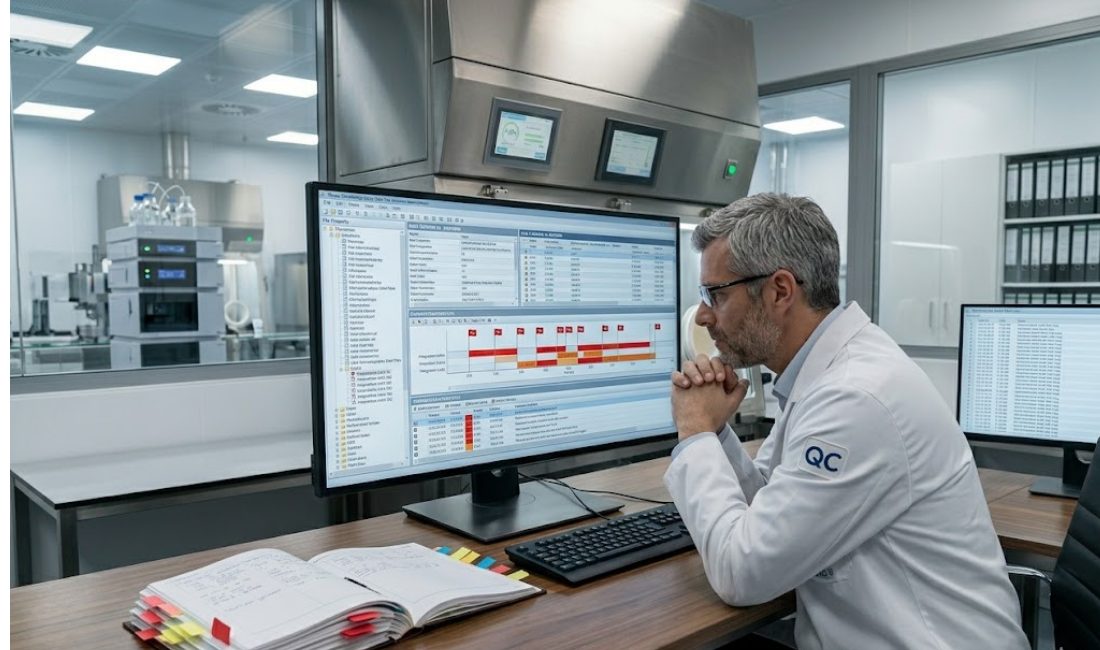
In the modern laboratory, paper records are only one part of the story. Investigators now perform deep-dives into electronic audit trails to identify unauthorized activities. An audit trail acts as a “digital diary” that records every action taken within a software system. When reviewing Laboratory Records FDA systems, investigators look for instances where users disabled audit trails or modified system clocks. Furthermore, they check if analysts logged in as “Administrators” to bypass security features or delete failing results.
If the electronic record does not match the printed summary, the investigator will conclude that the data is untrustworthy. This forensic scrutiny is a primary method for how the agency identifies “Testing into Compliance.” Therefore, your Quality Unit must perform regular, independent reviews of these digital logs. Knowing How FDA Detects Data Integrity Manipulation in Laboratories allows your team to find these digital “ghosts” before the FDA does. A validated system with restricted user access is your best defense against forensic findings.
Scrutinizing Raw Data and “Orphan” Files
Investigators often look for “orphan data”—files that exist on an instrument’s hard drive but are not linked to any official report. These files are frequently found in folders labeled “Test,” “Demo,” or “Practice.” In a GxP environment, there is no such thing as a “practice” run with a real sample. Every injection must be accounted for in the Laboratory Records FDA history. If an investigator finds a failing result in an orphan folder that you did not report, they will cite the facility for hiding data.
To prevent this, laboratories must implement strict data-handling SOPs that prohibit “demo” runs with actual samples. Furthermore, the Quality Unit should conduct periodic “hard drive audits” to ensure no unauthorized files exist. This level of oversight is a key reason Why Contract Testing Laboratories Receive FDA Warning Letters. Contract labs often face immense pressure to deliver passing results to clients, leading to the creation of hidden “trial” injections. Transparency throughout the data lifecycle is the only way to maintain regulatory trust.
Evaluating Management of Out-of-Specification (OOS) Results
The way a laboratory handles failed test results provides a window into its overall quality culture. Investigators meticulously review OOS investigations to ensure they are thorough and scientifically sound. They check if the lab followed the FDA Guidance on Investigating OOS Test Results. If a lab frequently blames “analyst error” without a clear root cause, the investigator will view it as an attempt to invalidate legitimate failures.
A compliant OOS investigation must be a transparent search for the truth. You must investigate the manufacturing process, the laboratory equipment, and the analyst’s technique. Furthermore, you must implement a CAPA that prevents the failure from recurring. If your Laboratory Records FDA history shows the same OOS happening repeatedly, it proves your Quality System is ineffective. Knowing How FDA Investigators Evaluate Quality Systems helps you build a robust investigation framework that satisfies regulatory scrutiny.
Equipment Calibration and Qualification Records
Analytical instruments must be qualified for their intended use and calibrated regularly. During an audit, investigators check the “use logs” and “maintenance logs” of every HPLC, GC, and spectrophotometer. They verify that the instrument was in a “validated state” the day the sample was tested. If a calibration sticker is missing or expired, the investigator will question every result generated by that machine. This technical gap is a common source of Form 483 observations.
Firms must maintain a rigorous schedule for Preventative Maintenance (PM) and Operational Qualification (OQ). In addition, you must document every repair, no matter how minor, in the equipment log. This level of detail is a cornerstone of FDA Inspection Preparation for Medical Device Companies and biologics labs. If an investigator sees that an instrument was repaired but not re-qualified before being put back into service, they will invalidate all subsequent data.
Personnel Training and Competency Records
The FDA believes that a Quality System is only as strong as the people operating it. Consequently, they spend significant time reviewing personnel training files. They look for proof that analysts possess the education and experience required for their tasks. Furthermore, they check if analysts have been trained on the specific versions of the SOPs used during a test. If an analyst performs a test using an outdated procedure, the Laboratory Records FDA entry for that test is non-compliant.
Investigators also use unscripted interviews to gauge actual competency. They might ask a chemist to explain the integration parameters used for a specific peak. If the chemist cannot explain the scientific rationale behind their actions, it suggests a training gap. This behavioral detection is why knowing How FDA Investigators Conduct GMP Inspections is so valuable. You must coach your team to provide factual, confident answers that reflect a deep understanding of cGMP.
Reagent, Standard, and Sample Traceability
Every material used in a laboratory test must be fully traceable. Investigators check the “reagent room” to ensure that every chemical has a clear expiration date and a record of when it was opened. If a lab uses an expired reference standard, the entire test is legally invalid. Furthermore, you must prove that samples were stored in a controlled environment to prevent degradation. A gap in the “Chain of Custody” for a sample is a major red flag for investigators.
Firms must implement a robust labeling and tracking system for all standards and reagents. This is especially critical during FDA Inspection Preparation for Biologics Manufacturers, where materials are often temperature-sensitive and have short shelf lives. If an investigator finds a reagent that lacks a “received” date, they will cite the lab for a lack of material control. Treating these materials as critical components ensures that your analytical foundation remains beyond reproach.
The Quality Unit’s Oversight of Lab Data
The Quality Unit (QU) bears the ultimate responsibility for the integrity of laboratory data. The FDA expects the QU to perform periodic, independent reviews of raw electronic data and audit trails. If the QU only reviews the “Final Report,” they are failing in their oversight duty. Investigators will ask the Quality Manager how they verify that the results are real. A lack of Quality Unit involvement is a top reason for the escalation of 483s into Warning Letters.
The QU must have the authority to challenge the lab’s findings. They should also be involved in reviewing all “aborted” or “cancelled” runs. If the lab has a high rate of aborted tests that are never explained, the FDA will assume the lab is hiding failures. Implementing a regular How to Conduct an Internal GMP Audit Before an FDA Inspection program allows the QU to practice this oversight. By identifying these “lab habits” early, you can correct them before an official investigator identifies them as systemic violations.
Final Preparations for Laboratory Scrutiny
As the date of an inspection nears, the laboratory must finalize its physical and digital appearance. Ensure that all logbooks are bound, paginated, and signed. Verify that all electronic systems have their “Sleep” and “Screen Lock” functions enabled to prevent unauthorized access. Furthermore, perform a final sweep of all waste containers and desk drawers to ensure no unofficial records or “sticky notes” remain in the facility.
The final layer of preparation involves ensuring that your IT department is ready to assist the investigator with software navigation. A smooth, transparent demonstration of your electronic systems builds immense confidence. By showing the investigator that you have nothing to hide and that your systems are “hardened” against manipulation, you turn a high-risk audit into a successful demonstration of compliance. Ultimately, impeccable Laboratory Records FDA management is the best way to safeguard your facility’s future.
Conclusion
The scrutiny of laboratory records is the ultimate test of a pharmaceutical facility’s commitment to quality. By focusing on the ALCOA+ principles, maintaining strict audit trail controls, and ensuring total traceability, laboratories can build a defense based on truth and transparency. Regulatory readiness is not a periodic task; it is a permanent state of operation. Companies that prioritize honest data and robust Quality Unit oversight will not only pass their inspections but will also ensure the safety of the patients who rely on their products.
FAQs
1. What is the most common laboratory record finding? The most frequent finding is a failure to contemporaneously record data, followed closely by the failure to review electronic audit trails for unauthorized changes.
2. Can a laboratory still use paper notebooks? Yes, but the FDA considers the electronic record from the instrument as the “original.” You must maintain and review the dynamic electronic data alongside the paper entries.
3. What does “Testing into Compliance” mean? This is the deceptive practice of running a sample multiple times and only recording the result that passes, while deleting or ignoring all failing results.
4. How long must we keep laboratory records? Under cGMP, most laboratory records must be kept for at least one year after the expiration date of the batch, though many firms keep them much longer for legal protection.
5. Why does the FDA check system clocks on computers? Investigators check system clocks to ensure that analysts are not changing the time to “backdate” entries, which is a common form of data integrity manipulation.
6. Does the Quality Unit need to be scientists? While not strictly required by law, the FDA expects QU personnel to have sufficient technical knowledge to understand and audit the complex scientific data they are reviewing.
References
- FDA 21 CFR Part 211 – Laboratory Controls – The primary federal regulation governing the manufacturing and testing of pharmaceutical products in the U.S.
- FDA Guidance: Data Integrity and Compliance with CGMP – The official agency document clarifying expectations for electronic record-keeping and ALCOA+ principles.
- ICH Q7 Good Manufacturing Practice Guide for APIs – An international standard providing detailed requirements for laboratory records and quality oversight.
- WHO Annex 5: Guidance on Good Data and Record Management – The global benchmark for maintaining consistent and accurate documentation in GxP environments.
Many global manufacturers identify critical analytical vulnerabilities by utilizing a mock FDA inspection led by former agency investigators to evaluate their laboratory systems. To ensure your facility remains compliant and to build authority around your regulatory defense, explore expert FDA Inspection Readiness and How Gap Analysis Prevents FDA Enforcement Actions. Implementing these professional assessments ensures your laboratory records remain beyond reproach in the eyes of any investigator.